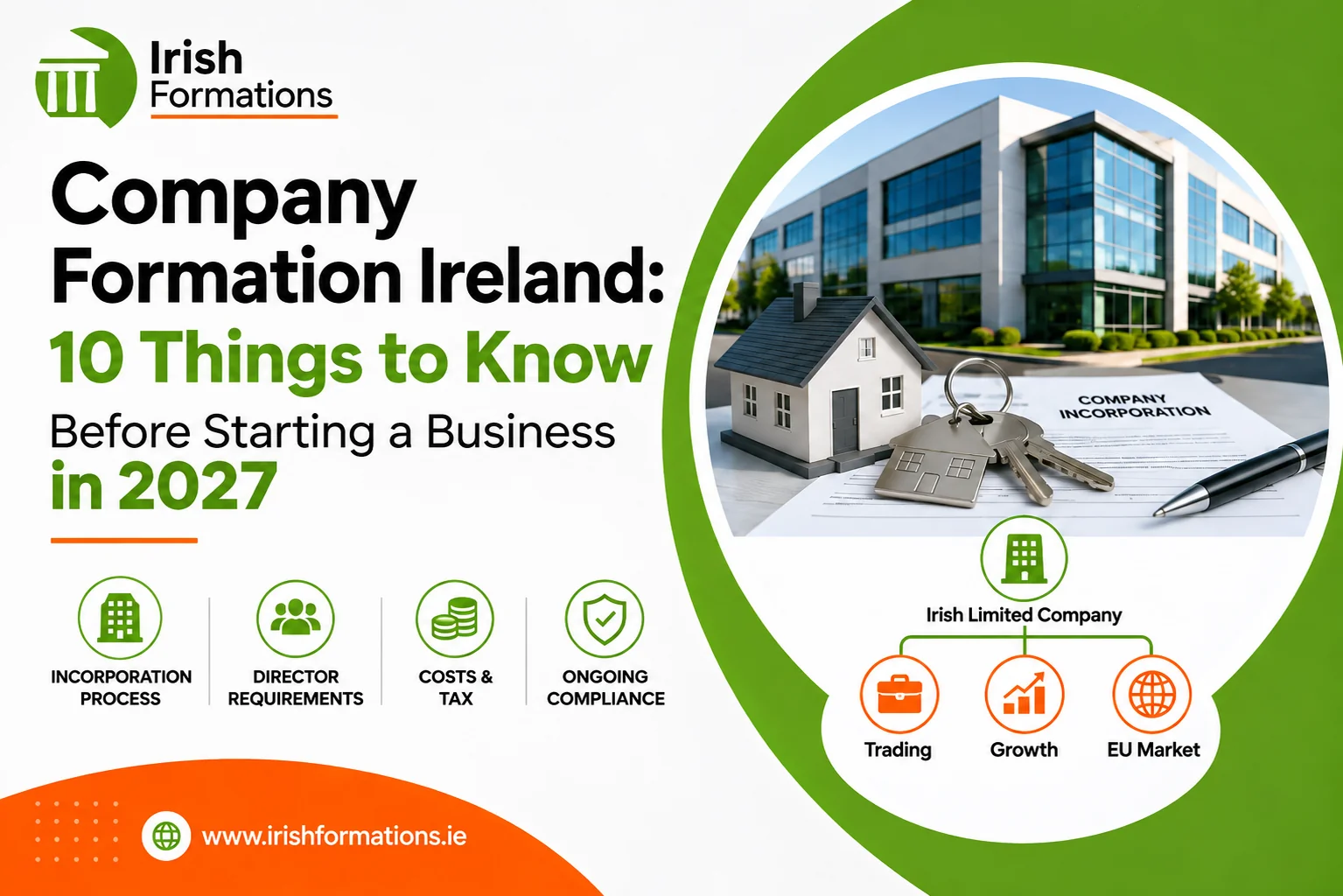
Company Formation Ireland: 10 Things to Know Before Starting a Business in 2027
Planning to start a company in Ireland in 2027? Whether you are an Irish entrepreneur launching a new business, an overseas investor entering the European market or an established company expanding internationally, understanding the incorporation process is essential.
Company formation Ireland is a popular search for entrepreneurs looking to establish an Irish limited company. However, forming a company involves more than simply obtaining a Certificate of Incorporation. Directors must consider the company structure, registered office, statutory requirements, taxation and ongoing compliance obligations.
At Irish Formations, we have been helping Irish and international entrepreneurs establish companies since 2009. Our experience supporting company formation in Ireland allows us to guide customers through the incorporation process and help them prepare for trading.
If you are considering establishing an Irish company in 2027, here are ten important things to know before getting started.
1. Choose the Right Company Structure in Ireland
One of the first decisions when starting a business is selecting the appropriate legal structure.
The most common company structure for small and medium-sized businesses is the Private Company Limited by Shares (LTD).
An LTD company is a separate legal entity from its shareholders, offering limited liability protection subject to applicable legal exceptions.
Other company types available in Ireland include:
- Designated Activity Company (DAC)
- Company Limited by Guarantee (CLG)
- Public Limited Company (PLC)
- Unlimited Company
The most appropriate structure depends on the company’s intended activities, ownership arrangements and commercial objectives.
For most entrepreneurs establishing a standard trading business, an LTD is a practical option.
Our detailed guide on how to set up a company in Ireland explains the incorporation process and the information required.
2. Understand Irish Company Director Requirements
Before proceeding with company formation in Ireland, you must understand the statutory requirements for directors and company secretaries.
An Irish LTD company can have a single director. However, where there is only one director, a separate company secretary must be appointed.
Companies with two or more directors may appoint one of those directors as company secretary.
Directors must be at least 18 years old and must not be disqualified from acting.
Another important consideration is director residency.
Generally, Irish companies must have at least one director resident in the European Economic Area (EEA). Where no director satisfies this requirement, a Section 137 non-resident director bond may be necessary unless an exemption applies.
The Companies Registration Office provides official guidance on Irish company registration and statutory obligations.
Irish Formations can also assist with nominee company secretary services and the arrangement of Section 137 bonds.
3. Every Irish Company Needs a Registered Office Address
Every company incorporated in Ireland must maintain a registered office address within the State.
This is the company’s official legal address, recorded on the public register maintained by the Companies Registration Office.
The registered office is used for statutory correspondence, legal notices and communications from public authorities.
Importantly, the registered office does not necessarily have to be the company’s principal trading location.
This is particularly useful for overseas entrepreneurs establishing an Irish company without immediately renting commercial premises.
Irish Formations provides a professional registered office address in Ireland, helping businesses meet their statutory requirements.
4. Prepare Your Company Registration Documents Correctly
An important part of successful company formation in Ireland is ensuring that incorporation documents are accurate and complete before submission.
The information generally required includes:
- Proposed company name
- Director and company secretary details
- Registered office address
- Shareholder information
- Share capital and share allocations
- Principal business activity
- Company constitution
- Director identification information
The incorporation application is submitted to the CRO using Form A1 and the company’s constitution.
Directors must also satisfy the applicable CRO identity verification requirements, which may involve a PPSN, Identified Person Number or Verified Identity Number.
Incomplete documentation, inconsistencies or missing verification information can delay incorporation.
For further details, consult the CRO’s official incorporation guidance.
Our company formation packages include assistance with preparing and submitting the necessary incorporation documentation.
5. Allow Sufficient Time for Company Incorporation
How long does it take to register a company in Ireland?
The answer depends on several factors, including the completeness of the application, the CRO’s processing workload and whether additional requirements apply.
For straightforward applications, incorporation may be completed within several working days. However, delays at the CRO can extend processing times, and a particular completion date cannot be guaranteed.
Applications involving non-resident directors may require additional preparation, particularly where a Section 137 bond or identity verification is necessary.
It is also important to distinguish between incorporation and becoming fully operational.
Receiving a Certificate of Incorporation confirms that the company has been legally registered. Additional steps, including tax registration and operational arrangements, may still be required before trading.
For a detailed explanation of current processing considerations, read our article on how long it takes to form a company in Ireland.
6. Understand the Cost of Company Formation in Ireland
The cost of setting up a company in Ireland varies depending on the incorporation package and additional services required.
Irish Formations offers company formation packages starting from €219, with more comprehensive packages available for businesses requiring additional documentation and support.
Other potential expenses include:
- Registered office address services
- Nominee company secretary services
- Section 137 non-resident director bonds
- Tax registration assistance
- Accounting and ongoing compliance services
For international entrepreneurs, these additional requirements should be considered before placing an incorporation order.
It is also important to distinguish between the initial cost of incorporating a company and the recurring costs of maintaining it.
You can compare our Irish company formation packages to identify an appropriate option for your business.
7. Non-Residents Can Form a Company in Ireland
You do not need to be an Irish citizen or live in Ireland to own shares in an Irish company.
Entrepreneurs based in the United Kingdom, United States, Canada, Germany and other countries can establish Irish limited companies, provided the relevant legal and regulatory requirements are satisfied.
Ireland is an attractive location for international companies seeking to establish a European presence.
However, overseas founders should consider several additional matters, including director residency, company secretary appointments, registered office requirements, tax registration and identity verification.
In particular, directors living outside the EEA may need to arrange a Section 137 bond where the company has no EEA-resident director.
Our dedicated guide to non-resident company formation in Ireland explains the process for international entrepreneurs.
UK-based founders can also read our article on registering an Irish company as a UK-resident director.
8. Register Your Company for the Appropriate Taxes
After incorporation, directors must consider the company’s tax registration obligations.
An Irish company will generally need to register for Corporation Tax where applicable and may also require VAT, employer PAYE or other tax registrations depending on its activities.
VAT registration is not automatically required for every newly incorporated company.
The obligation depends on the company’s business activities, taxable turnover and relevant cross-border transactions.
Some businesses may also be eligible to register voluntarily.
Revenue may request evidence of genuine business activity or intended trading arrangements when assessing registration applications.
For additional guidance, read our article on who needs to register for VAT in Ireland.
The Revenue Commissioners’ company tax registration guidance also explains the registration process.
9. Understand Your Ongoing Company Compliance Obligations
Company formation in Ireland is only the beginning of a company’s statutory responsibilities.
Once incorporated, an Irish company must comply with the Companies Act 2014 and other applicable legislation.
Important ongoing obligations include:
- Filing annual returns with the CRO
- Maintaining statutory registers and company records
- Registering beneficial ownership information
- Maintaining a registered office address
- Filing applicable tax returns
- Preparing financial statements where required
- Notifying the CRO of relevant changes to company particulars
A newly incorporated Irish company generally has its first Annual Return Date six months after incorporation.
The first annual return does not ordinarily require financial statements, but it must still be filed within the applicable statutory deadline.
Companies must also submit beneficial ownership information to the Register of Beneficial Ownership within the prescribed timeframe.
Irish Formations offers company secretarial and compliance support to assist businesses with their ongoing statutory obligations.
10. Work With an Experienced Irish Company Formation Agent
Choosing the right company formation provider can make the incorporation process easier, particularly for first-time entrepreneurs and international businesses.
An experienced formation agent can assist with preparing company documentation, coordinating statutory requirements and identifying potential complications before an application is submitted.
At Irish Formations, we have been helping businesses establish Irish companies since 2009.
We work with Irish entrepreneurs, overseas investors, international groups and established businesses seeking to expand into Ireland.
Our services include company incorporation, registered office addresses, company secretarial support, non-resident director bonds and assistance with tax registration.
We also help international businesses establish trade-ready Irish companies, supporting foreign direct investment and providing a practical route into the Irish and European markets.
Our focus is on providing clear guidance, efficient administration and ongoing support throughout the company formation process.
Start Your Company Formation in Ireland for 2027
If you are planning to establish an Irish limited company in 2027, preparing early can help you avoid unnecessary delays.
Choosing the appropriate company structure, understanding director residency requirements and arranging the correct incorporation documents are important first steps.
Whether you are launching a local business or establishing an international subsidiary, Irish Formations can help you navigate the incorporation process.
Ready to establish your Irish company?
Visit Irish Formations — Company Formation Ireland to explore our services, or follow our guide to register a company in Ireland.
With experience dating back to 2009, our team is available to help you take the next step towards establishing your Irish business.