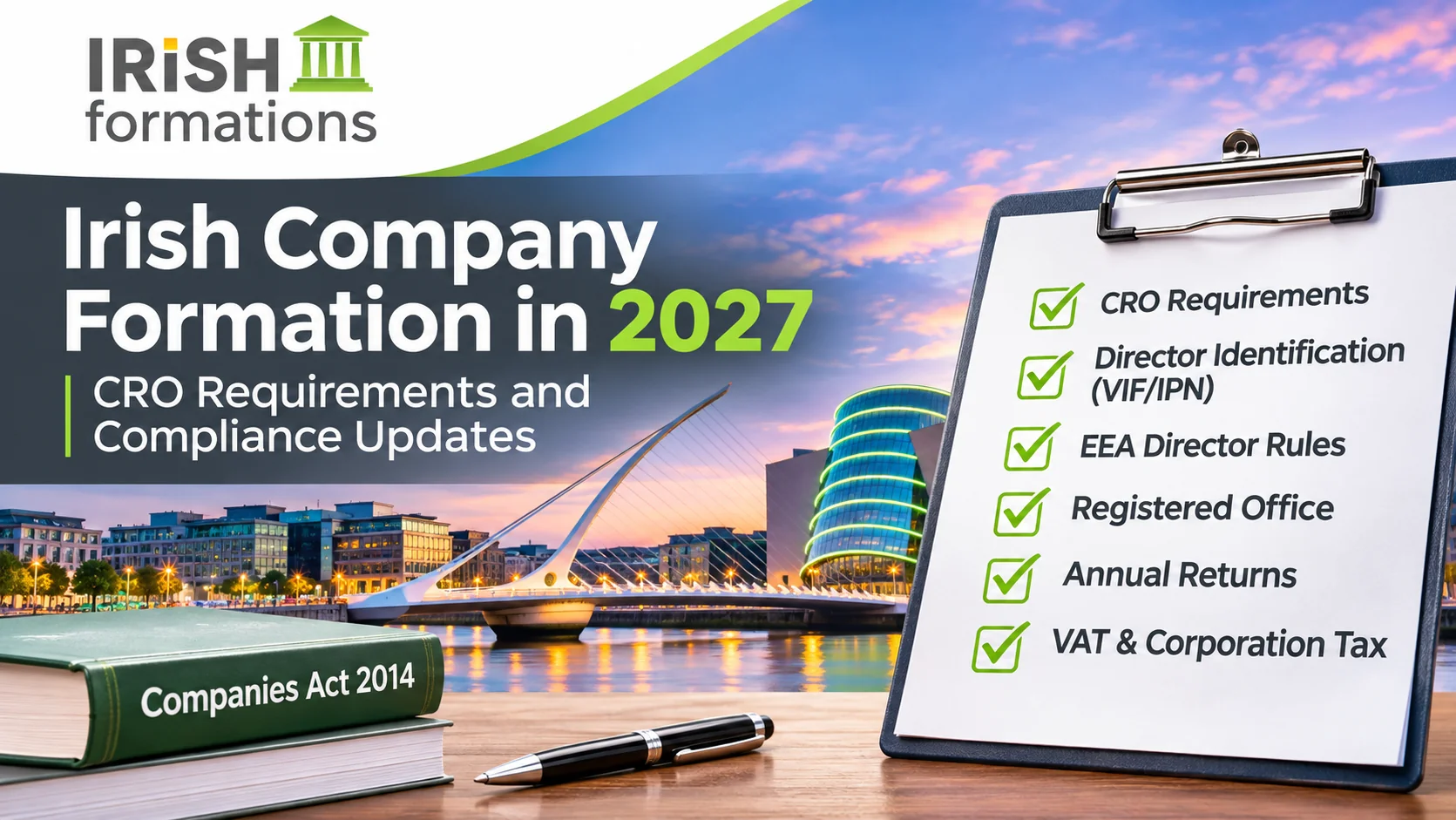
Irish Company Formation in 2027: CRO Requirements and Compliance Updates
Published: 11 November 2026 | By Mark Hegarty, Managing Director, Irish Formations
Planning to register an Irish company in 2027? Understanding the latest Companies Registration Office (CRO) requirements is essential, particularly if you are incorporating a company from outside Ireland.
Irish company formation involves more than submitting an application and receiving a Certificate of Incorporation. Directors must satisfy identification requirements, appoint the appropriate company officers, provide an Irish registered office address and prepare for ongoing statutory obligations.
At Irish Formations, we have been helping Irish and international entrepreneurs establish limited companies since 2009. Our team works with CRO applications and company compliance requirements on a daily basis.
In this article, we examine the requirements businesses should understand when preparing for company formation in Ireland in 2027, including an important change introduced by the CRO during 2026.
1. CRO Director Identity Verification: An Important 2026 Change
One of the most significant recent developments affecting Irish company formation concerns the verification of directors who do not hold an Irish Personal Public Service Number (PPSN).
On 30 April 2026, the CRO introduced updated requirements for the Verification of Identity Form (VIF).
The CRO no longer accepts VIF forms witnessed remotely or online.
Instead, the person completing the form and the witness must be physically present together when the form is witnessed and signed.
The CRO also requires the updated version of the VIF. Earlier versions submitted after the change took effect are rejected.
This is particularly important for overseas directors who may previously have expected to complete the identification process entirely through remote witnessing.
What does this mean for non-resident directors?
A director without an Irish PPSN will generally need an Identified Person Number (IPN), obtained through the applicable CRO identification process.
Directors should allow sufficient time to complete their identification requirements before the incorporation application is submitted.
For further guidance, see our non-resident company formation services.
Official source: CRO News and Announcements.
2. Does an Irish Company Need an Irish-Resident Director?
A common misconception is that every Irish limited company must appoint a director who lives in Ireland.
This is not the case.
Under the Companies Act 2014, an Irish company generally requires at least one director who is resident in the European Economic Area (EEA).
The EEA includes EU member states, together with Iceland, Liechtenstein and Norway.
For example, a company with a director resident in Germany, France, Spain or the Netherlands can generally satisfy the EEA director residency requirement without appointing an Irish-resident director.
Where none of the directors is resident in the EEA, the company will generally require a Section 137 Bond or qualify for an applicable statutory exemption.
A Section 137 Bond normally covers a two-year period.
This requirement should be considered before submitting an application, particularly by founders based in the United Kingdom, United States, Canada or other non-EEA countries.
Read more about registering a company in Ireland.
3. CRO Processing Times: Why Businesses Should Plan Ahead
The time required to incorporate an Irish company can vary depending on the CRO’s processing workload, the application scheme used and whether the submitted documents are complete.
Although company incorporation can be completed relatively quickly, applicants should avoid assuming that registration will always be completed within a fixed number of working days.
Additional time may be required where:
- A director must complete the VIF and IPN process.
- A Section 137 Bond must be arranged.
- The proposed company name requires additional consideration.
- The company has a complex shareholding structure.
- The CRO requests amendments or further information.
At Irish Formations, we review incorporation documentation before submission and help clients address potential issues as early as possible.
For further information, read our guide to how long it takes to form a company in Ireland.
4. Registered Office Requirements Remain Essential
Every Irish limited company must maintain a registered office address within the Republic of Ireland.
This is the company’s official legal address and the location to which statutory correspondence and notices may be delivered.
The registered office does not necessarily have to be the location where the company trades.
For international founders, having a reliable registered office provider can be particularly valuable because important CRO and Revenue correspondence must be received and handled appropriately.
Irish Formations provides a registered office address service for companies requiring an Irish statutory address.
Businesses should also ensure that any change of registered office is correctly notified to the CRO.
5. Company Secretary Requirements for Irish Limited Companies
An Irish private company limited by shares (LTD) may have a single director.
However, where a company has only one director, that individual cannot also act as the company secretary.
The company must appoint a separate person or eligible corporate entity to perform the secretary role.
The company secretary plays an important part in corporate administration and statutory compliance, including assisting with annual returns and maintaining company records.
For international founders who do not have a suitable individual available, professional company secretarial services can provide a practical solution.
It is important to remember that appointing a professional company secretary does not remove the directors’ own statutory responsibilities.
6. Corporation Tax and VAT Registration After Incorporation
Receiving a Certificate of Incorporation does not automatically mean that a company is registered for all relevant Irish taxes.
Following incorporation, a company may need to register with the Revenue Commissioners for Corporation Tax, VAT and employer PAYE, depending on its circumstances.
VAT registration deserves particular attention.
For 2026, the principal domestic VAT registration thresholds include €42,500 for services and €85,000 for goods, subject to the applicable rules and exceptions.
Some businesses may be required to register regardless of those thresholds, while others may qualify for voluntary registration.
International businesses should also consider the location of their customers, the nature of their supplies and where their commercial activities are carried out.
Read our guide to who needs to register for VAT in Ireland.
Official guidance: Revenue Commissioners – VAT Registration.
7. The First Annual Return: A Deadline New Directors Should Understand
A newly incorporated Irish company must generally file its first annual return with the CRO six months after incorporation.
The first annual return does not normally require financial statements.
The return must be filed within the applicable statutory filing period, generally 28 days after the annual return date.
Importantly, this obligation applies even where the company has not commenced trading.
Missing annual return deadlines can result in penalties and may affect the company’s compliance status.
New directors should therefore understand their statutory obligations from the date of incorporation rather than waiting until the company begins generating revenue.
8. Register of Beneficial Ownership Requirements
Irish companies are generally required to identify and register their beneficial owners with the Central Register of Beneficial Ownership (RBO).
For newly incorporated companies, the initial beneficial ownership filing is generally required within five months of incorporation.
A beneficial owner is usually a natural person who ultimately owns or controls more than 25% of the company, although other control criteria may apply.
Companies must also maintain accurate internal beneficial ownership information and update their filings where required.
These obligations are particularly important for companies with overseas shareholders, corporate ownership structures or multiple classes of shares.
9. Why International Founders Need to Consider More Than Incorporation
Ireland continues to attract international entrepreneurs and businesses seeking access to European markets.
However, successful international expansion requires more than establishing a legal entity.
Foreign founders should consider the company’s tax position, management arrangements, trading activities, commercial substance and ongoing reporting requirements.
Incorporating an Irish company does not automatically establish Irish tax residence for every purpose, guarantee VAT registration or provide permission to live and work in Ireland.
At Irish Formations, we assist international clients with the incorporation and corporate administration aspects of establishing their Irish presence.
Where specialist advice is required, we can introduce clients to appropriate accountants, tax advisers, solicitors and other professional service providers.
Our role is to help clients take the first steps towards establishing their Irish business and connect them with the right expertise for their wider requirements.
10. Preparing for Irish Company Formation in 2027
If you intend to establish an Irish limited company in 2027, preparation is essential.
Before proceeding, consider the following:
- Confirm your proposed company name and business activity.
- Decide on the directors, secretary and shareholders.
- Establish whether an EEA-resident director or Section 137 Bond is required.
- Identify any directors who need to complete the VIF/IPN process.
- Arrange a suitable Irish registered office address.
- Determine the company’s share capital and constitution.
- Consider Corporation Tax, VAT and other tax registrations.
- Prepare for beneficial ownership and annual return filing obligations.
Addressing these matters early can help reduce avoidable delays and establish a stronger foundation for the business.
Why Choose Irish Formations?
Irish Formations has supported Irish and international entrepreneurs since 2009.
Our experience covers company incorporation, registered office services, company secretarial support, non-resident company formations and ongoing corporate administration.
We understand that company formation is often the first stage of a much larger business journey.
Whether you are establishing a new Irish business or expanding an existing international company into Ireland, our team can help you understand the incorporation requirements and introduce you to specialist professional advisers where appropriate.
Ready to establish your Irish company?
Explore our company formation services in Ireland or visit Irish Formations to get started.
This article reflects the requirements and guidance available as of 11 November 2026. Further regulatory changes may occur before or during 2027. Readers should check the latest CRO and Revenue guidance before proceeding.